

Everyone Lives Inside Partial Dashboards
Future society will not be a system people understand. It will be a set of interfaces they learn to navigate.

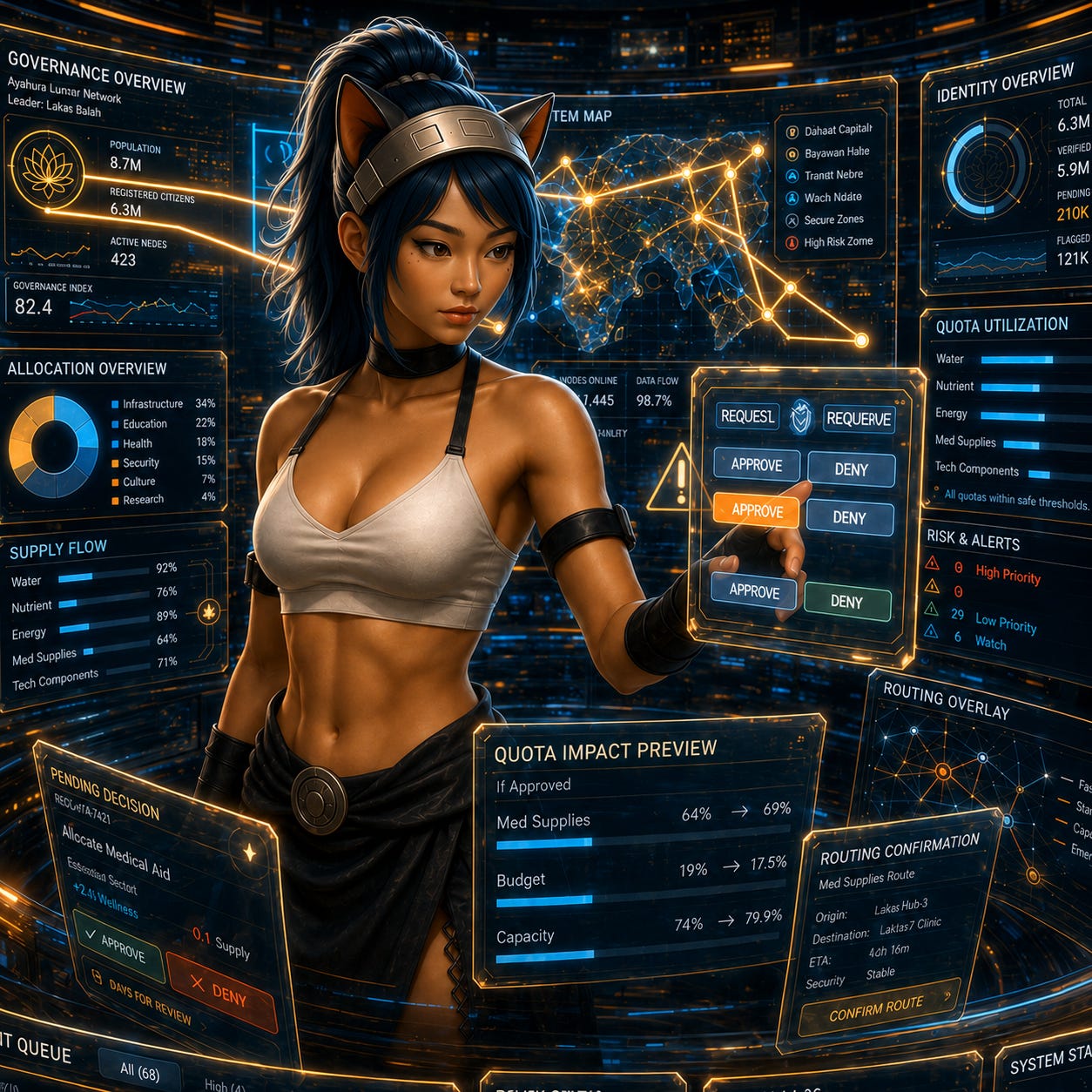
This post was developed through dialogue with GPT-5.5.
A recent essay by Ugo Bardi considered Stefan Brunnhuber’s proposal for a two-tiered monetary system: ordinary money for ordinary transactions, plus a second, purpose-restricted currency for public-good investment. The restricted currency could be issued digitally, perhaps by central banks, and used only for approved projects: hospitals, renewable energy, education, ecosystem repair, infrastructure, and other goals that fall under the broad heading of sustainable development.
The point is to break fungibility. Ordinary money is powerful because it can be turned toward almost anything. That is also why it corrodes boundaries. It can buy food, labor, influence, silence, political access, media patronage, research agendas, bureaucratic patience, institutional forgiveness, and a great deal else. Brunnhuber’s proposal tries to create a monetary instrument that cannot do all of that. It can move resources, but only through authorized channels and toward authorized purposes.
Bardi summarizes the idea sympathetically, then pushes it further. If artificial intelligence is going to help manage a restricted monetary system, why use money at all? Why not allow AI to allocate resources directly? If a region needs hospitals, allocate steel, concrete, labor, energy, transport, and medical equipment. Do not create money, route the money through institutions, and hope the institutions acquire the resources correctly. Just allocate the resources.
At that point, the conversation leaves monetary reform and enters older territory. It becomes a version of the socialist calculation problem, updated for an age of machine intelligence. Could AI do what Soviet planners could not? Could modern computation integrate the complexity of production, logistics, energy systems, ecological constraints, human needs, institutional incentives, and political priorities better than price signals and markets?
That is an interesting question, but it quickly reveals a deeper one.
The real issue is not whether a two-tier currency, AI-assisted planning, green monetary policy, or direct resource allocation would work. The deeper issue is that social provisioning has already exceeded human-scale intelligibility.
Modern economies are not systems anyone understands.
That sentence sounds exaggerated only because we are used to treating abstractions as explanations. We talk about the market, the state, finance, labor, regulation, globalization, logistics, monetary policy, energy, infrastructure, and technology as if each term names a comprehensible machine. It does not. Each term points toward a dense cluster of arrangements, habits, incentives, institutions, tools, and expectations. Each contains more detail than a human being can master. The total arrangement exceeds the comprehension of any individual mind.
A person can understand a slice. A banker understands certain balance-sheet operations. A regulator understands a reporting framework. A farmer understands input costs, land, weather, machinery, debt, subsidies, and market exposure. A truck dispatcher understands delivery constraints. A software engineer understands one subsystem. A hospital administrator understands billing codes, staffing ratios, vendor contracts, legal exposure, and institutional politics. A political theorist understands a simplified model. An economist understands a representation built from selected variables.
Nobody understands the thing itself.
This matters because arguments about future social organization often proceed as if a future system can be described from above. We imagine that if we change the monetary system, or add AI to planning, or reform governance, or optimize resource allocation, we will be able to describe the new arrangement as a designed mechanism.
That may be the wrong expectation.
A near-future provisioning system will not be simpler than the current one. It will almost certainly be more complex. It will include more sensors, more software, more automated decisions, more machine-readable identity layers, more compliance systems, more risk scoring, more forms of programmable money, more environmental accounting, more logistics optimization, more automated enforcement, and more institutional dependency on models no one fully understands.
That does not mean it will be more rational. Complexity is not rationality. A system can be computationally sophisticated and still be corrupt, brittle, idiotic, predatory, or morally incoherent. It can process more information while making worse decisions. It can optimize a measured variable while destroying the conditions that made the variable meaningful.
But whether it works well or badly, it will not be transparent.
People living inside such a system will not understand it. They will navigate it.
That means the old science-fictional temptation to explain the future society as if it were a designed mechanism is probably wrong. Future society will not be understood by its inhabitants. It will be navigated. People will know where the interfaces are, what permissions they have, what signals matter, what penalties exist, what loopholes remain, and which authorities or machine processes they dare not trigger.
The more realistic future is not one where the system is transparent and rational. It is one where everyone lives inside partial dashboards.
This is already true. Most people do not know how their bank works. They know what the app shows them. They do not know how the food system works. They know what appears on the shelf and what it costs. They do not know how medical billing works. They know whether the claim was approved, denied, delayed, or mysteriously recoded. They do not know how platform governance works. They know which post was removed, which account was throttled, which appeal disappeared, and which phrase seems dangerous this month.
You cannot see the system in operation. You can only see the dashboard, and the dashboard is not the system. It is an abstract representation of the parts that are legible to you, relevant to you, or permitted to appear.
That distinction will become more important. In a highly mediated society, power does not need to explain itself in full. It only needs to present a usable front end.
Approved.
Denied.
Flagged.
Subsidized.
Restricted.
Escalated.
Pending review.
Not eligible.
Temporarily unavailable.
Please contact support.
The experience of rule becomes the experience of interface.
This clarifies the limitation of Bardi’s AI-planning speculation. Even if AI could optimize resource allocation better than human bureaucrats, the output would still require legitimacy, interpretation, contestation, and enforcement. The AI might “know” that a region should receive less water, less steel, fewer hospital beds, or more lithium extraction. But the people affected will not experience that as optimization. They will experience it as rule, fate, deprivation, privilege, corruption, or divine judgment, depending on the symbolic frame around it.
So the challenge is not just computation. It is governance under opacity.
That phrase names the condition we are entering. Decisions will be made through systems too complex for ordinary comprehension. Some decisions will be made by humans using machine outputs. Some will be made by machines under human-defined goals. Some will be made by institutional procedures nobody alive designed from scratch. Some will emerge from feedback loops between markets, states, platforms, insurers, logistics networks, energy systems, security agencies, and automated scoring systems.
People will still demand reasons.
The reasons they receive may not be the real reasons. They may be legal reasons, public relations reasons, compliance reasons, ideological reasons, therapeutic reasons, or machine-generated summaries of decision pathways that cannot actually be understood by the people invoking them. The system will need to maintain legitimacy without being fully legible.
This is where myth enters.
Myth does not mean falsehood. It means a compressed symbolic account that lets people inhabit a reality too large to grasp directly. Every complex society requires myth in this sense. Liberalism has myths. Markets have myths. Bureaucracies have myths. Science has myths. Democracy has myths. Technocracy has myths. AI will have myths.
A complex provisioning system will generate stories about what it is doing and why. Some will be official. Some will be oppositional. Some will be conspiratorial. Some will be religious. Some will be managerial. Some will be generated by the system itself.
One faction will say the machine is optimizing fairness. Another will say it is enforcing elite control. Another will say it is protecting the biosphere. Another will say it is punishing the disobedient. Another will say no one is in control and the whole thing is an emergent accident. Another will treat the system as a spirit, oracle, demon, or god.
The point is not that all of these accounts are equally true. They are not. The point is that none of them will be identical with the system. They will be ways of living under opacity.
This has consequences for fiction, analysis, and political imagination.
The old schematic mode is inadequate. It is tempting to build a future society by deciding how the currency works, how the government works, who owns the robots, what the AI is allowed to do, how citizens receive income, and how dissent is handled. That kind of design exercise can be useful. It gives a writer or theorist a working model. But if it becomes too clean, it becomes false.
Actual systems do not present themselves as coherent diagrams. They present themselves as obligations, delays, workarounds, permissions, shortages, rumors, classifications, queue positions, subsidy categories, loyalty scores, appeals processes, and practical know-how.
A person inside the system does not need to understand the total structure. He needs to know how to get medicine for his mother. She needs to know which office still has human discretion. They need to know whether a certain phrase in an application will trigger review. A contractor needs to know which procurement rule is real and which one is ceremonial. A smuggler needs to know which sensor grid is maintained and which one exists only in budget documents. A local official needs to know which metrics can be gamed without attracting attention. A dissident needs to know which institutions are still capable of embarrassment.
This is local practical knowledge. It will matter more, not less.
When a system becomes too complex to understand globally, intelligence migrates to the edges. People become experts in narrow points of encounter. They learn how the machine behaves when it touches their lives. They collect stories. They compare outcomes. They develop folk theories. They discover that the system says one thing, does another, and occasionally makes exceptions for reasons no one can explain.
That is not primitive. It is adaptive.
The more opaque the system becomes, the more important tacit knowledge becomes. Official knowledge tells people what the system claims to be. Tacit knowledge tells them how to survive inside it.
This is also why trust becomes the scarce resource.
A simple system can be checked. A complex system must be trusted, at least in part. But complexity also corrodes trust because it becomes difficult to distinguish error from corruption, necessity from ideology, incompetence from malice, and tradeoff from betrayal.
If a hospital closes, why did it close? Was it demographic decline, financialization, staffing shortages, insurance dysfunction, energy costs, regulatory burden, bad management, local corruption, algorithmic resource allocation, political punishment, or a rational consolidation plan?
The answer may be several of these at once. But the affected population will need a story. If no credible story is available, anger will supply one.
This is the legitimacy crisis built into governance under opacity.
The system may even be making defensible decisions. That will not save it. A defensible decision that cannot be explained in a trusted language becomes socially indistinguishable from arbitrary power. This is one of the hardest problems for technocracy. It assumes that good process and better information can substitute for shared meaning. They cannot.
People do not live inside optimization functions. They live inside moral worlds.
This does not mean optimization is useless. It means optimization is subordinate to legitimacy. A society cannot be governed as a logistics problem alone. Provisioning is material, but acceptance is symbolic. The question is not only who gets water, electricity, medical care, housing, transport, and food. The question is whether people experience the allocation as lawful, tolerable, comprehensible, deserved, imposed, rigged, humiliating, or sacred.
That is where the future becomes harder to describe than most futurists want to admit.
It is not enough to say the AI allocates resources. Which AI? Authorized by whom? Audited how? Obeyed by which institutions? Interpreted through which ideology? Appealed through which process? Protected by which armed force? Hacked by which faction? Trusted by which class? Hated by which region? Worshiped by which subculture?
It is not enough to say the market decides. Which market? Structured by which laws? Distorted by which subsidies? Owned by which actors? Dependent on which energy regime? Backstopped by which central bank? Monitored by which platforms? Insured by which risk models?
It is not enough to say democracy decides. Which voters? Presented with which choices? Informed by which media? Constrained by which debts, emergencies, courts, donors, bureaucracies, and inherited systems?
Every clean answer dissolves into complexity.
This does not make analysis useless. It means analysis should become more modest and more precise. Instead of pretending to describe the whole machine, we should describe the places where people actually meet it: the form, the app, the queue, the denied claim, the ration card, the subsidy portal, the machine-generated explanation, the human clerk who quietly knows better, the official who no longer has discretion, the local workaround, the rumor that turns out to be operationally true.
That is more honest than the god’s-eye schematic.
It is also more useful. A total description of a near-future provisioning order is probably impossible. But a description of how a person encounters it can be exact. The system does not need to be fully knowable for its pressures to be felt. The whole machine can remain obscure while its local effects are unmistakable.
This may be the right way to think about the future now. Not as a plan. Not as a doctrine. Not as a clean transition from capitalism to socialism, markets to planning, money to allocation, liberalism to technocracy, or human governance to AI governance.
The future will be an accretion of interfaces.
Some will be humane. Some will be predatory. Some will be stupid. Some will be brilliant. Some will be impossible to appeal. Some will be quietly sabotaged by the humans assigned to operate them. Some will become sacred. Some will become hated. Most will become normal.
The future will not arrive as a system people understand, much less as one conceived by think tank humans in advance and then implemented.
It will arrive as a dashboard that tells them what they are allowed to do next.
So, would it be a failing in the education system when people don't understand how things work?
As a Gen-X citizen, I know how food gets to the supermarket. I know how money gets to the bank, how loans are processed, how checkbooks are balanced, and how the medical system works.
I also understand how computer programs work, why Microsoft is fucking things up, and how to fix it.
I know how to do simple repairs to vehicles, and how to change oil, drain gas, and change tires.
I think trying to figure out everything would scramble an AI's circuits.
If flesh and blood minds couldn't figure out how to build infrastructure, then AI might not be any better.
Thanks for the interest, KMO. A very insightful post!