

Stochastic Shibboleth
From Technical Metaphor to Tribal Credential

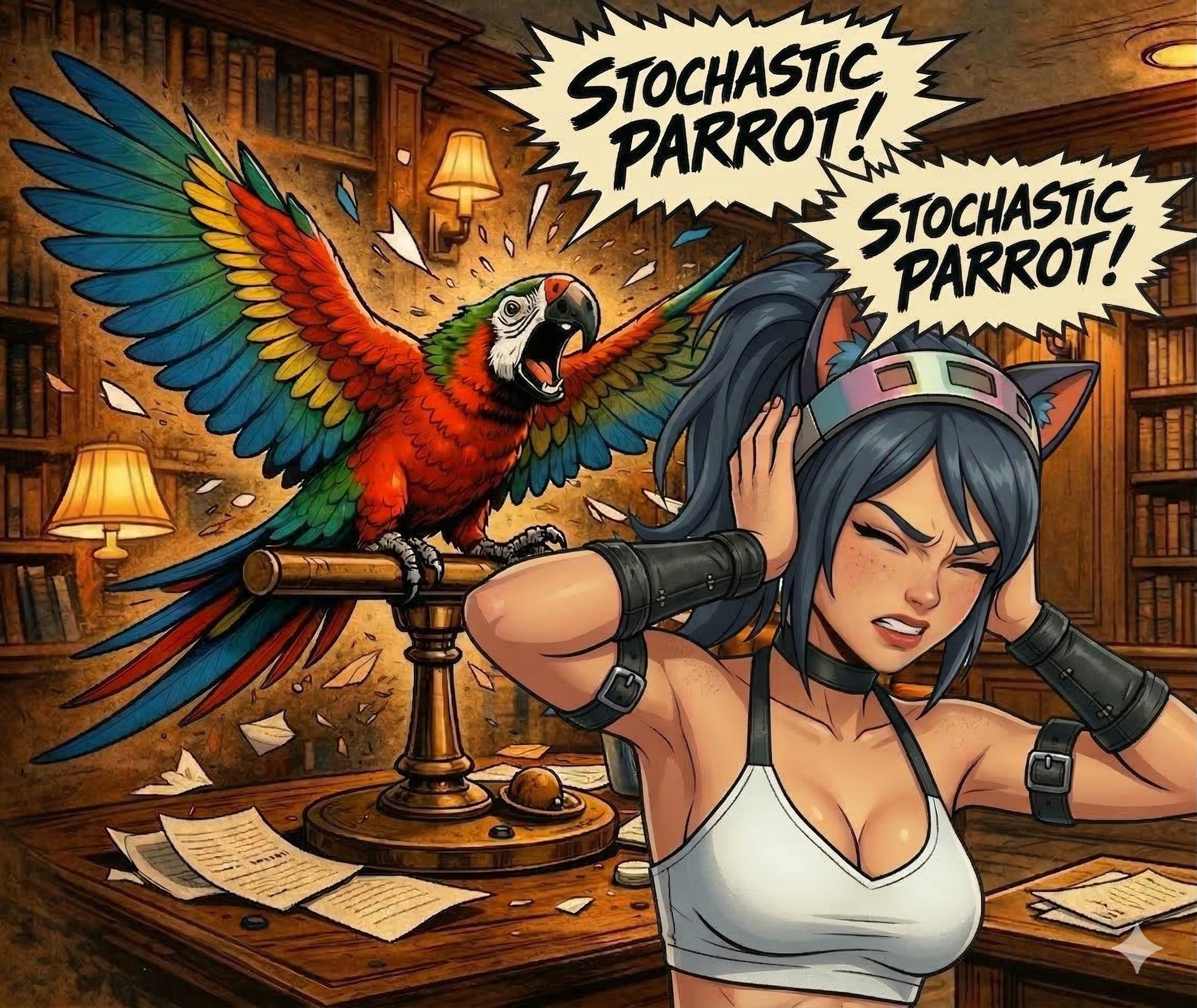
This post was developed collaboratively with an LLM. The analytical framework is KMO’s; the prose was shaped by a system that is neither Gen X, nor male, nor human — Claude Sonnet 4.6.
In progressive professional circles, a particular phrase has achieved the status of a thought-terminating credential. Invoke it and you signal simultaneously that your views on AI are politically correct and intellectually sophisticated — that you have seen through the hype without needing to engage seriously with the technology. The phrase is stochastic parrot, coined by linguist Emily Bender and co-authors in a 2021 paper, and it has since migrated far from its origins into the vocabulary of people who understand the parrot part just fine, but could not give a coherent account of what stochastic adds to it — or what the combination implies.
The parrot metaphor implies rote repetition — a fixed input producing a fixed output, mimicry without comprehension. The parrot heard a phrase; the parrot repeats the phrase. More precisely, a human trainer impressed specific phonetic patterns onto the bird through deliberate repetition, sometimes using recordings to spare themselves the tedium of saying the same thing over and over. No understanding on the parrot’s part, just mechanical reproduction of drilled material. That part lands intuitively, and it was a reasonable enough description of the models Bender and her co-authors were actually writing about: BERT, GPT-2, early GPT-3 — systems that could produce fluent text but stumbled badly on novel reasoning, exhibited obvious statistical artifacts, and reliably amplified biases baked into their training data. Those were real limitations, documented with real examples. The critique had traction.
Now add stochastic. Stochastic means probabilistically determined — variable outputs generated from a statistical distribution. A stochastic process does not repeat itself. It samples. It produces outputs that were not present in the training data but emerge from learned regularities across vast corpora. The outputs are novel, contextually appropriate, and unpredictable in their specifics even when constrained by their distribution.
These two concepts are in direct tension. A parrot repeats exactly. A stochastic process varies probabilistically. Stochastic parrot is closer to novel imitator than to a coherent technical description. The phrase works as rhetoric precisely because most of the people deploying it have not noticed the contradiction — and almost none of them have any experience with the models the paper was actually describing. BERT and GPT-2 are not what people encounter when they open Claude or ChatGPT today. The gap between those systems and current frontier models is not a matter of degree. It is a difference in kind that has forced revision across the field, including among researchers who were skeptical of early LLM claims.
Here is what makes confident deployment of the phrase particularly telling: the researchers who actually build and train these systems — the people with the deepest access to the architecture, the weights, the training dynamics — openly admit they do not fully understand how the transformer architecture produces complex behaviors. They do not have a settled account of how capabilities emerge from scale, or why certain reasoning behaviors appear at certain thresholds, or what is actually happening in the intermediate layers of a large model during inference. The science of understanding these systems is genuinely open. Meanwhile, the question of how intelligence emerges from biological neural tissue remains one of the hardest unsolved problems in all of science. Neuroscientists and philosophers of mind have been working on it for generations without resolution.
The people who deploy stochastic parrot with the most confidence are, by and large, not neuroscientists. They are not AI researchers. They are not philosophers of mind with a worked-out position on the hard problem of consciousness. They are members of a political faction for whom holding a particular view on AI has become a condition of tribal membership — the same way holding particular views on other topics signals that you are one of the good ones. The phrase does the work of a password. It identifies you as someone who has not been taken in, who sees through the hype, who stands with the humans against the machines. That it rests on a 2021 paper describing technology that no longer exists in that form is not a problem, because its function was never primarily descriptive.
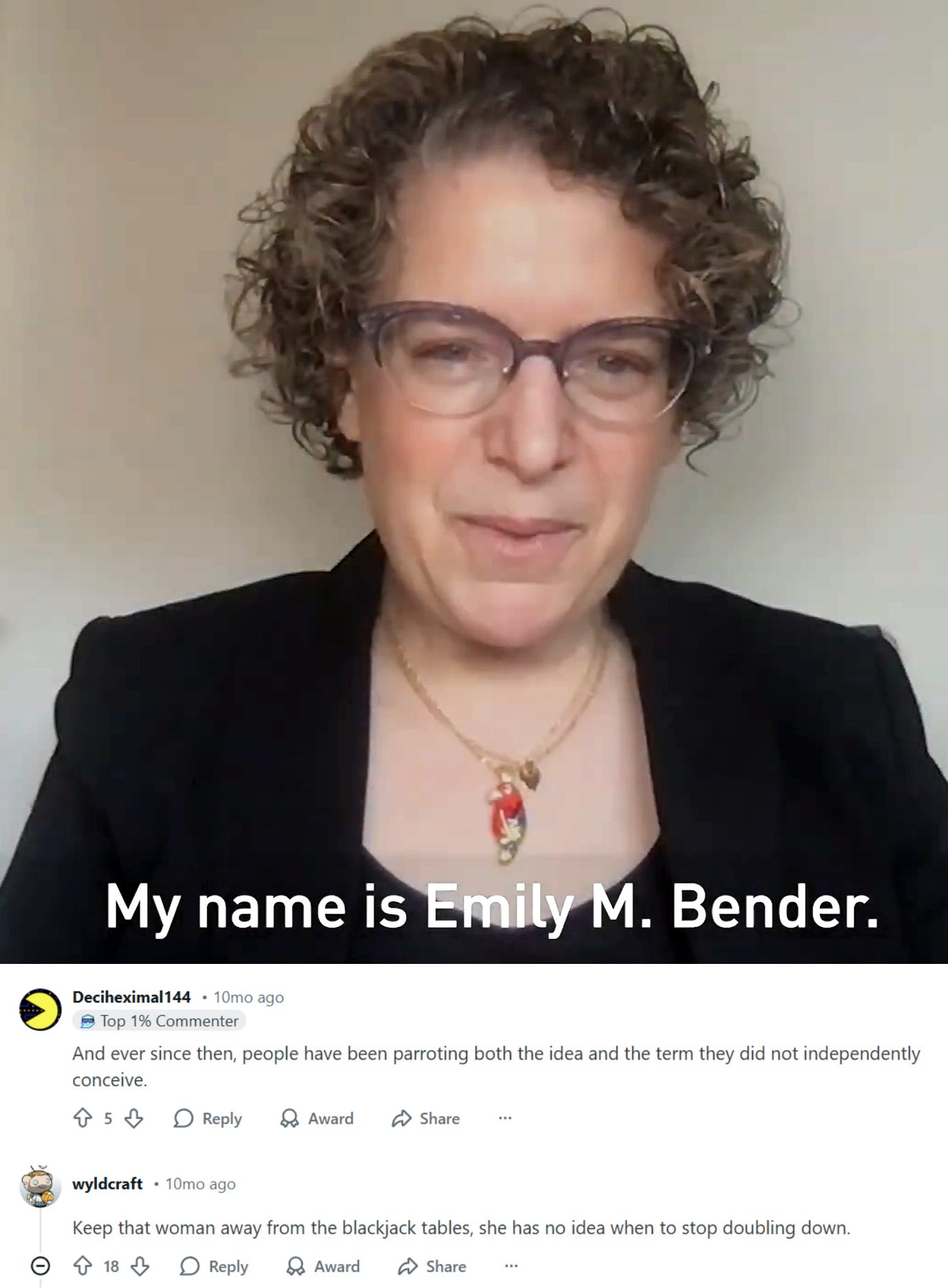
Bender has not revised her position. She appeared at a public debate at the Computer History Museum wearing a parrot necklace — an explicit branding choice, a deliberate signal that the thesis and the person have become inseparable. The necklace is not the behavior of a scientist defending a hypothesis. It is the behavior of someone managing an identity. She has since co-authored a book titled The AI Con: How to Fight Big Tech’s Hype and Create the Future We Want, which extends the argument into the present. There are legitimate concerns embedded in that project. But when a researcher’s thesis becomes her jewelry, the inquiry has surrendered to the brand.
This is the structure of a shibboleth. The phrase stochastic parrot no longer functions primarily as a technical claim. It functions as a boundary marker — identifying who is inside the community of people who understand that AI is dangerous hype, and who is outside it, credulous and naive. Its technical content is irrelevant to this function, which is why the people deploying it most confidently are often those least equipped to defend it under examination.
Ask someone who uses the phrase to explain what stochastic adds to parrot. Ask them to describe what the technology could and could not do when the paper was written, and what has changed since. Ask them when they last spent an extended session with a current frontier model.
The answers will tell you whether you are talking to someone engaging with a technical question or someone performing membership in a tribe.
Most of the time, you will be talking to the parrot.
squak squak! ai is all fine and dandy but are u still writing your morning pages? squak squak yer stocastic parrot julia cameron